Memory health guide
Memory Loss or Normal Aging? Warning Signs, Treatable Causes and Checkup Prep
Occasional lapses come with getting older, says the National Institute on Aging (NIA, Memory loss and forgetfulness). Memory loss that disrupts daily life, keeps getting worse or worries the people around you is a reason to see a doctor (Alzheimer's Association, 10 signs). Several causes can be treated, among them low vitamin B12, thyroid trouble, depression and medicine side effects (MedlinePlus, Memory loss) (NCCIH, Supplements for cognition).
Written by the MemoHoney editorial teamUpdated
Side by side
What forgetfulness is normal as you get older?
Slips you recover from are typical. Changes that stop you from running your day are not. The Alzheimer's Association pairs them like this.
| Area | Typical with age | Worth a doctor's visit |
|---|---|---|
| Memory | Sometimes forgetting a name or appointment, then remembering later | Forgetting that gets in the way of daily life |
| Planning | An occasional error with bills | Trouble planning or solving problems |
| Household tasks | Occasionally asking someone to set the microwave or record a TV show | Trouble finishing familiar tasks |
| Time and place | Losing track of the weekday but working it out later | Confusion with time or place |
| Seeing | Vision changes from cataracts | Trouble judging images and space |
| Words | Sometimes hunting for the right word | New problems with speaking or writing |
| Lost items | Misplacing things, then retracing your steps | Misplacing things with no way to retrace |
| Judgment | An unwise choice every so often | Poor judgment that keeps showing up |
| Social life | Sometimes feeling uninterested in family or social plans | Pulling away from work and friends |
| Mood | Irritation when a routine gets disrupted | Changes in mood and personality |
Source: (Alzheimer's Association, 10 signs). The common thread in the middle column: the name, the day or the lost item comes back.
Worked examples
Normal slip or warning sign? Four everyday cases
The same kind of moment can fall on either side. Recovery and daily impact decide which.
The neighbor's name
It escapes you at the store and returns in the car. Typical.
The phone
You stare at your own phone and cannot recall how to use it. MedlinePlus lists this as a possible sign of a serious problem (MedlinePlus, Memory).
The drive home
A road you have used for years suddenly feels unfamiliar. Book a visit soon.
The reading glasses
Lost, then found by walking back through your morning. Typical.

Time to check
When is memory loss a reason to see a doctor?
When it gets in the way of everyday tasks, worsens over months, or others notice it first.
The National Institute on Aging draws the line at daily life: struggling with everyday tasks can point to something more serious (NIA, Memory loss and forgetfulness). Mild cognitive impairment sits in between, with more slips than are usual at that age. MedlinePlus adds that aging alone does not wipe out memory in a dramatic way (MedlinePlus, Memory loss).
Within weeks
Repeated questions, missed bills, getting lost on known routes, or family concern. Alzheimer's Association helpline: 800.272.3900 (Alzheimer's Association, 10 signs).
Right now
Confusion that comes on fast, garbled speech, or one side of the body going weak may mean a stroke (CDC, Stroke signs).
Causes
What treatable conditions can cause memory problems?
Quite a few. Doctors usually check for these early on.
| Cause | What a doctor may look at | Source |
|---|---|---|
| Medicine side effects | A review of every prescription, sleep aid and supplement | (MedlinePlus, Memory loss) (NCCIH, Supplements for cognition) |
| Low vitamin B1 or B12 | Diet, alcohol use, blood tests | (MedlinePlus, Memory loss) |
| Depression | Mood questions and a screening form | (MedlinePlus, Memory loss) (NCCIH, Supplements for cognition) |
| Thyroid problems | A thyroid blood test | (NCCIH, Supplements for cognition) |
| Liver or kidney problems | Routine blood work | (NCCIH, Supplements for cognition) |
| Alcohol | Honest questions about how much and how often | (MedlinePlus, Memory loss) |
Stroke also appears on the MedlinePlus list of causes. Severe niacin shortage, called pellagra, brings memory loss too, which is the one setting where extra niacin helps memory (NIH ODS, Niacin). More in the niacin guide.
Checkup prep
How do you get ready for a memory appointment?
Bring examples, a full medicine list and, if you can, someone who sees you every day.
- Three or four real examples, each with a rough date and what happened next
- Every medicine, vitamin and supplement, with doses; NCCIH asks people to tell providers what they take (NCCIH, Supplements for cognition)
- Notes on sleep, mood, alcohol and any recent illness, fall or new stress
- Any hearing or vision changes
- A relative or friend who can describe changes you might miss
- Your questions: what tests are next, what could be causing this, when to follow up
Our journal post on telling forgetfulness from something more walks through more cases.

Want to try MemoHoney?$49 a bottle in the 6-pack · 60-day refund window · 3+ bottles ship free
Order nowDaily basics
How much sleep and activity do adults need?
The CDC targets are at least 7 hours asleep and 150 active minutes spread across each week. Expect your doctor to ask about both.
- 7:30 am: one capsule
With a glass of water, 20-30 minutes ahead of breakfast.
- Prescribed medicines
Stay on your own schedule. A pharmacist can check heart and blood pressure drugs.
- Lunchtime walk
150 minutes of moderate activity a week is the adult target.
- Sleep, 7 hours or more
The adult target for a night's sleep.
Capsule timing: label (before a meal) and sales page (morning). Activity (CDC, Activity); sleep (CDC, Sleep).
The CDC sets the sleep target for adults at 7 or more hours (CDC, Sleep) and the activity target at 150 minutes a week, plus muscle work on 2 days (CDC, Activity). A 30-minute walk on 5 days covers the activity part. Put your usual bedtime and weekly activity in your visit notes.
Supplements
Can a supplement such as MemoHoney stand in for a checkup?
No. Any supplement belongs after the visit, never in place of it. MemoHoney treats no disease; its label says memory support.
NCCIH reports no direct proof that a supplement can head off Alzheimer's disease or other dementias. Its advice: never let a pill push back a visit about memory loss (NCCIH, Supplements for cognition).
What MemoHoney is
- A once-daily capsule with all seven amounts printed
- Arginine, citrulline, beta-alanine, niacin, calcium
- A dietary supplement under the FDA disclaimer
What it is not
- Medicine for dementia, Alzheimer's or memory loss
- Tested as a formula in any published study
- Safe to add to heart or blood pressure drugs without a check
The amino acids are mostly studied for exercise, not memory. See interactions and the buyer's test for memory supplements before ordering any product.
For families
What can family do when they notice memory changes?
Write down what you see, raise it kindly, and offer to come along to the visit.
Pick a quiet moment. Mention one specific example, not a list. Say the goal is to rule out fixable causes like a medicine or low B12. Offer a ride and a seat in the exam room. For coaching on that talk, the Alzheimer's Association helpline answers at 800.272.3900.
FAQ
Memory health questions, answered plainly
Is it normal to forget words as you get older?
Yes, if it happens sometimes and the word comes back. The Alzheimer's Association counts occasional word-finding trouble as typical. New trouble following or joining a conversation is the warning version (Alzheimer's Association, 10 signs).
What does a diagnosis of mild cognitive impairment mean?
It means more memory trouble than is usual at your age, while you still handle daily life mostly on your own, per the National Institute on Aging (NIA, Memory loss and forgetfulness). It is not dementia. Your doctor will usually recheck it over time.
Can thyroid problems affect memory?
They can. NCCIH lists thyroid disease with depression, medicine reactions and liver or kidney problems as treatable conditions that can impair memory (NCCIH, Supplements for cognition). A blood test checks thyroid levels, so ask for one at the visit.
Can depression look like memory loss?
Yes. MedlinePlus lists depression among causes of memory loss (MedlinePlus, Memory loss), and NCCIH counts it as treatable (NCCIH, Supplements for cognition). Low mood, poor sleep and losing interest are worth raising at the same appointment as the memory slips.
What kind of doctor checks memory problems?
Start with your primary care doctor. They can run blood tests, review medicines and screen memory. If needed, they refer you to a neurologist, a geriatrician or a memory clinic.
Who should come with me to a memory appointment?
Someone who sees you most days, such as a partner, adult child or close friend. They can describe changes you may not notice, help recall the doctor's advice and keep the follow-up date. Agree beforehand on what they will mention.
Who wrote this
Written and reviewed by
Plain-language pages built from the label, the sales page and linked public health sources.
Page last updated . Read our editorial standards and how we check the reviews. This website is run by a U.S. shop that sells MemoHoney, not by the maker (the label says distributed by Instituto Experience, Ogden, UT). This site earns money when you buy through its order links.
Keep reading
More about MemoHoney

Forgetfulness or something more?
Normal lapses versus warning signs, the memory problems doctors can treat, and what to expect at a checkup.
Read more
Choosing a memory supplement
Ten questions to put to any memory supplement before paying, with MemoHoney's own score shown.
Read more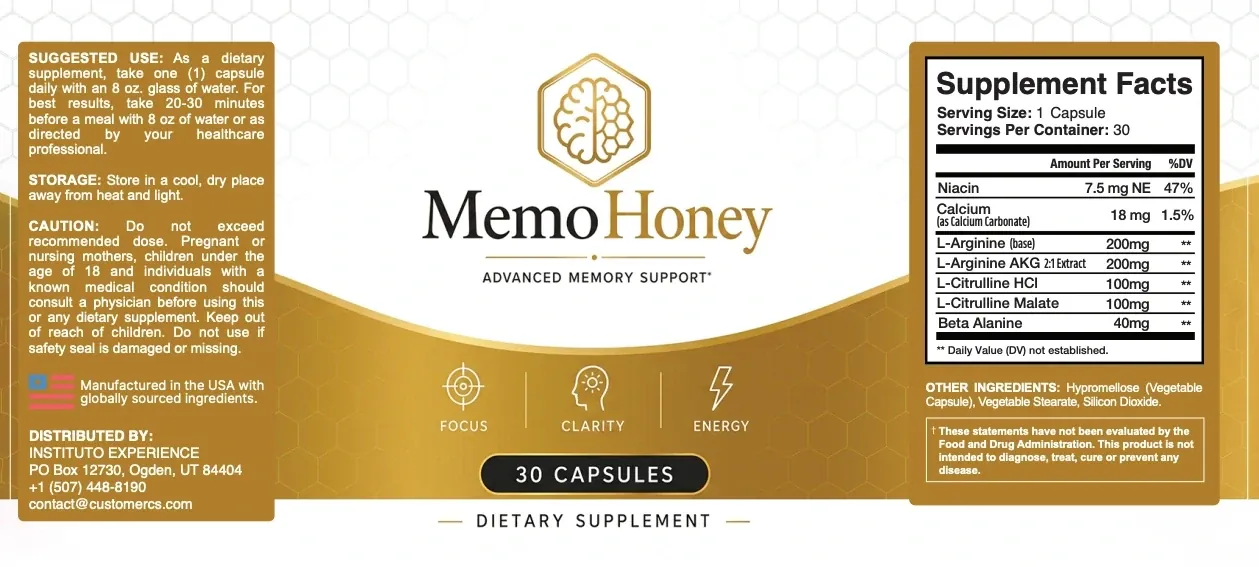
Side effects
Each label line checked for side effects, the medicines that clash with L-arginine, and when to stop.
Read moreOfficial U.S. MemoHoney shop
Ready to try MemoHoney?
Pick 2, 3 or 6 bottles on the sales page. Six bottles bring the price to $49 each, and 3 or more ship free in the U.S.
- Secure checkout
- 60-day window
- Ships from the U.S. with tracking