Ingredient profile
L-Citrulline in MemoHoney: Two Small Lines Next to Gram-Sized Studies
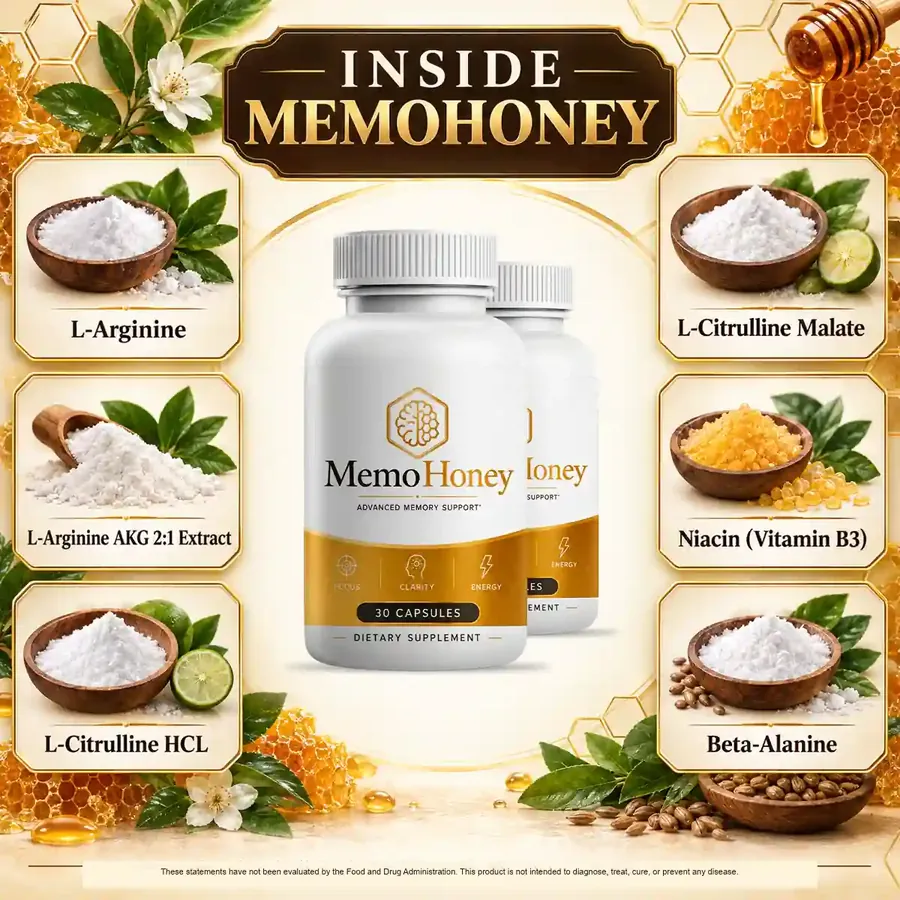
MemoHoney lists citrulline twice: 100 mg as L-citrulline HCl and 100 mg as citrulline malate, 200 mg per capsule. The body converts citrulline into arginine. Exercise studies gave 3 to 9 g, and NIH says the research offers no strong support (NIH ODS, Exercise supplements). No source we use links it to memory.
Written by the MemoHoney editorial teamUpdated
On the label
How much L-citrulline is in a MemoHoney capsule?
200 mg, printed as two lines of 100 mg. Together they rank third by weight, after the two arginine lines.
| Label name | L-Citrulline HCl |
|---|---|
| Scientific name | Amino acid |
| What it is | Amino acid |
| Position in the list | 5 of 7 (each line shows its own amount) |
| Per capsule | 100 mg |
| Amount used in research | Exercise studies used 3-8 g; ODS calls support weak |
| Strength of evidence | No memory evidence |
| Traditional or marketed use | Amino acid the body converts to arginine |
| Main caution | Some stomach upset in studies; months-long safety not well tested. |
Both lines are salts, so the citrulline itself weighs a little less than 200 mg. The bottle does not print the pure figure. All seven lines sit side by side in the ingredient comparison.
HCl and malate
Citrulline HCl or citrulline malate: why does MemoHoney use both?
The label gives no reason. Here is what each name means.
| Line | Per capsule | What the name means |
|---|---|---|
| L-Citrulline HCl | 100 mg | Citrulline bound to hydrochloride |
| L-Citrulline Malate | 100 mg | Citrulline bound to malic acid, the tart acid in apples |
Malate is the form behind the 8 g weightlifting result NIH reports (NIH ODS, Exercise supplements). Sports powders often combine forms. MemoHoney's label and sales page both stay silent on the reason for the split.
In the body
What does the body do with L-citrulline?
It turns citrulline into arginine. That is the main reason products pair the two.
Citrulline is absorbed
It is an amino acid the body also makes on its own. Watermelon is a well-known food source.
It becomes arginine
Citrulline gets rebuilt into arginine, so the two lines feed the same supply as MemoHoney's arginine lines.
Arginine feeds nitric oxide
Nitric oxide helps blood vessels widen. Yet in NIH's summary, even grams of arginine rarely changed nitric oxide or blood flow (NIH ODS, Exercise supplements).
So the chain exists on paper. Whether 200 mg moves any link in it has not been tested.
Research
What did L-citrulline studies find?
Mixed results at gram doses, all in exercise. NIH sums it up: the research does not give strong support.
| Who was studied | Dose | What happened |
|---|---|---|
| 41 weightlifters | 8 g citrulline malate | More repetitions and less soreness; 6 of 41 reported stomach discomfort |
| Treadmill test | 3 g ahead of the test, or 9 g spread across 24 hours | Performance was worse than with a placebo |
| Nonathletes | Up to 6 g a day for 4 weeks | No adverse effects reported |
| Use over months | Not studied enough | Long-term safety not adequately assessed |
Source for every row: (NIH ODS, Exercise supplements). One trial looked good, another looked bad, and neither tested memory.
Dose gap
200 mg next to 3 and 8 grams
Per capsule versus the smallest and largest single doses NIH describes.
Figures from NIH ODS (NIH ODS, Exercise supplements). The label allows one capsule a day.
Want to try MemoHoney?$49 a bottle in the 6-pack · 60-day refund window · 3+ bottles ship free
Order nowThe claim
Does L-citrulline help memory?
There is no good human evidence for it. NIH's citrulline summary covers exercise only.
The sales page ties MemoHoney to brain health and blood flow. For citrulline, the studies behind that idea are mostly in animals or at an early stage. None used 200 mg in people.
More broadly, NCCIH says direct proof that supplements ward off dementia is lacking. It warns against letting a supplement delay a visit about memory loss (NCCIH, Supplements for cognition). Worried about your memory? A doctor can check for treatable causes first.
Adding it up
Do you get citrulline from other products too?
Possibly, if you use sports powders. Count every source before adding MemoHoney.
Read your pre-workout
Many list citrulline or citrulline malate in grams per scoop. That dwarfs the 200 mg in a capsule.
Count arginine as well
Citrulline ends up as arginine. MemoHoney already adds 400 mg of arginine ingredients on top.
Keep to one capsule
The label says not to exceed the dose. Taking more breaks that rule and brings no known gain.
Safety
Is L-citrulline safe, and when is a doctor's OK needed?
At 200 mg, few problems are expected for healthy adults. Some medicine users should still check.
- Stomach discomfort was the side effect seen in the 8 g study
- Four weeks at up to 6 g a day caused no adverse effects in nonathletes
- Safety across many months has not been well studied (NIH ODS, Exercise supplements)
Your body turns citrulline into arginine. Mayo Clinic warns that arginine combined with nitrates, sildenafil or blood pressure pills may lower pressure too far (Mayo Clinic, L-arginine). Ask your doctor before starting. Keep taking your prescribed medicine.
The full side effects guide covers every MemoHoney ingredient.
Verdict
Is MemoHoney's citrulline worth paying for?
Judge it as a small extra, not a reason to buy.
In its favor
- Both amounts printed
- Far below doses tied to side effects
Against it
- About a fifteenth of the 3 g dose
- Weak support even at grams
Next, see the beta-alanine profile.
FAQ
L-citrulline in MemoHoney: buyer questions
Is L-citrulline better than L-arginine?
Neither looks strong in the research NIH reviews. Citrulline ends up as arginine in the body, which is why many products include both. For exercise, NIH calls citrulline's support weak and says arginine rarely changed nitric oxide (NIH ODS, Exercise supplements).
What is citrulline malate used for?
Mostly sports nutrition. The best-known study gave 41 weightlifters 8 g and saw more repetitions and less soreness, though 6 had stomach discomfort (NIH ODS, Exercise supplements). MemoHoney's malate line is 100 mg, a tiny share of that.
How much L-citrulline should I take a day?
No official daily amount exists. NIH describes studies at 3 to 9 g, and nonathletes handled as much as 6 g daily for a month without trouble (NIH ODS, Exercise supplements). With MemoHoney, stay at the label dose of one capsule, which gives 200 mg.
Is L-citrulline OK with blood pressure pills?
Talk to your doctor first. Citrulline becomes arginine, and Mayo Clinic says arginine plus blood pressure drugs can drop pressure too low (Mayo Clinic, L-arginine). Do not adjust your pills to make room for a supplement.
What are L-citrulline side effects?
Stomach discomfort is the one NIH reports, in 6 of 41 weightlifters taking 8 g (NIH ODS, Exercise supplements). At 200 mg a day it is less likely. If anything feels wrong, stop and phone your doctor.
Is it safe to take L-citrulline every day for months?
Nobody knows for sure. NIH says long-term safety has not been adequately assessed, though a month-long stretch at up to 6 g daily went smoothly (NIH ODS, Exercise supplements). Review it with your doctor at checkups.
Where does the citrulline in MemoHoney come from?
The label does not name a source. It says only that the capsules are made in the USA with globally sourced ingredients. Watermelon is a natural source of citrulline, but nothing on the bottle says its citrulline comes from fruit.
Does L-citrulline improve memory?
No good evidence shows that it does. NIH's citrulline research is about exercise, and NCCIH says supplements should never replace a checkup for memory loss (NCCIH, Supplements for cognition).
Who wrote this
Written and reviewed by
Plain-language pages built from the label, the sales page and linked public health sources.
Page last updated . Read our editorial standards and how we check the reviews. This website is run by a U.S. shop that sells MemoHoney, not by the maker (the label says distributed by Instituto Experience, Ogden, UT). This site earns money when you buy through its order links.
Keep reading
More about MemoHoney
L-arginine
Two arginine lines, 400 mg in all: who can relax, who should ask a doctor, and which drugs clash.
Read moreBeta-alanine
Why a gym-shelf amino acid appears on a memory label, and why 40 mg will not make you tingle.
Read more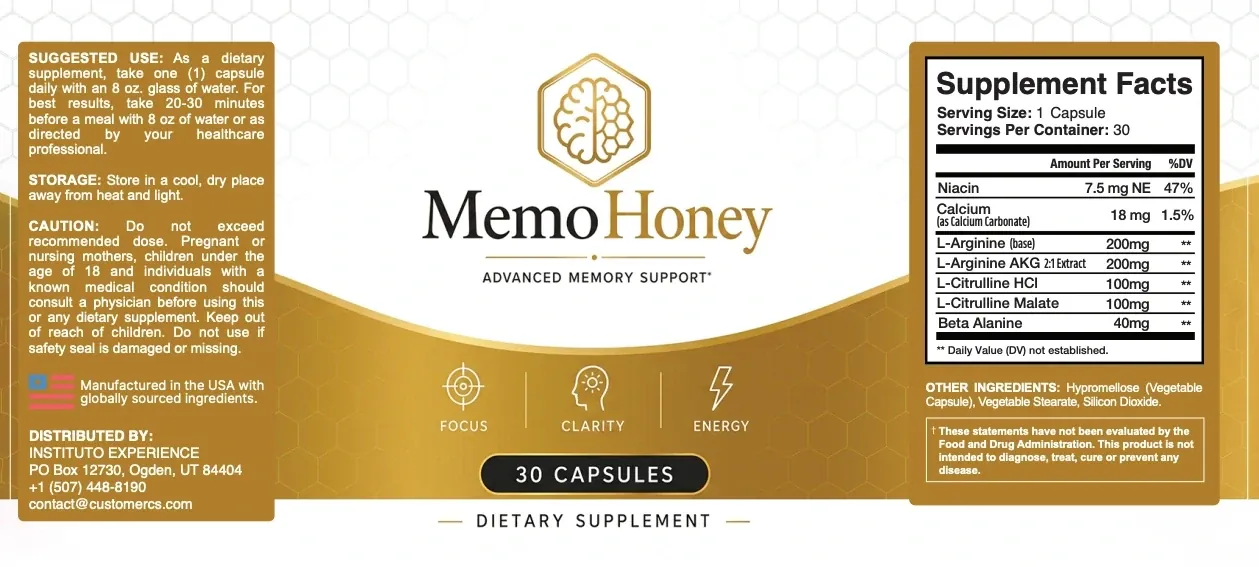
Side effects
Each label line checked for side effects, the medicines that clash with L-arginine, and when to stop.
Read moreOfficial U.S. MemoHoney shop
Ready to try MemoHoney?
Pick 2, 3 or 6 bottles on the sales page. Six bottles bring the price to $49 each, and 3 or more ship free in the U.S.
- Secure checkout
- 60-day window
- Ships from the U.S. with tracking