Buyer's guide
How to Choose a Memory Supplement: 10 Questions Before You Pay, With MemoHoney Scored
Most memory supplements lack strong evidence, so judge the label before the promise (NCCIH, Supplements for cognition). A product passes only if it prints every amount, matches studied doses, avoids disease claims, shows reviews you can verify, fits your medicines and spells out refunds. MemoHoney scores well on labeling and refunds, poorly on doses and memory evidence.
Written by the MemoHoney editorial teamUpdated
Start with evidence
Do memory supplements work?
For most products, nobody has shown that they do. That is why the label test matters.
NCCIH looked at the usual memory ingredients: curcumin, ginkgo, vitamin E, B vitamins and omega-3 fats. None showed a clear benefit, and direct proof that any supplement wards off dementia is missing (NCCIH, Supplements for cognition). A memory slip that worries you calls for a checkup first; the memory health guide explains why.
Ten questions will not prove a product works. They screen out hidden doses, illegal disease claims, staged reviews and weak refund terms, so you spend money only on what you can actually check.
The test
The 10-question buyer's test for any memory supplement
Score each question pass, partial or fail. Two fails on questions 1, 4 or 9 should end the purchase.
| # | Question | Passes when | Red flag |
|---|---|---|---|
| 1 | Is every amount printed? | Milligrams on each line | "Proprietary blend" with one total |
| 2 | Do doses match the studies? | Same range as the research | Milligrams where trials used grams |
| 3 | Is each ingredient studied for memory? | Human memory research exists | Studied for something else |
| 4 | Is the FDA wording honest? | The standard disclaimer, no approval claim | Claims of FDA approval, or a badge naming no facility |
| 5 | Are claims backed by evidence? | Linked human studies | Disease words: cure, reverse, Alzheimer's |
| 6 | Can you verify the reviews? | Tied to real orders | Stock faces, perfect scores, no dates |
| 7 | Is the ad free of celebrity or recipe hooks? | Plain product facts | A famous face or a kitchen "recipe" story |
| 8 | Is it the product you think it is? | Distributor and panel match | A near-identical name or domain |
| 9 | Does it fit your medicines? | Drug cautions named, or cleared by a pharmacist | Only a generic "consult a physician" |
| 10 | Are refund terms in writing? | Days, conditions, return address | "Satisfaction guaranteed" with no details |
Questions 1 to 3
Does the label show doses that match the research?
Read the panel, not the front. Then put each amount next to the dose used in studies, and ask what those studies measured.
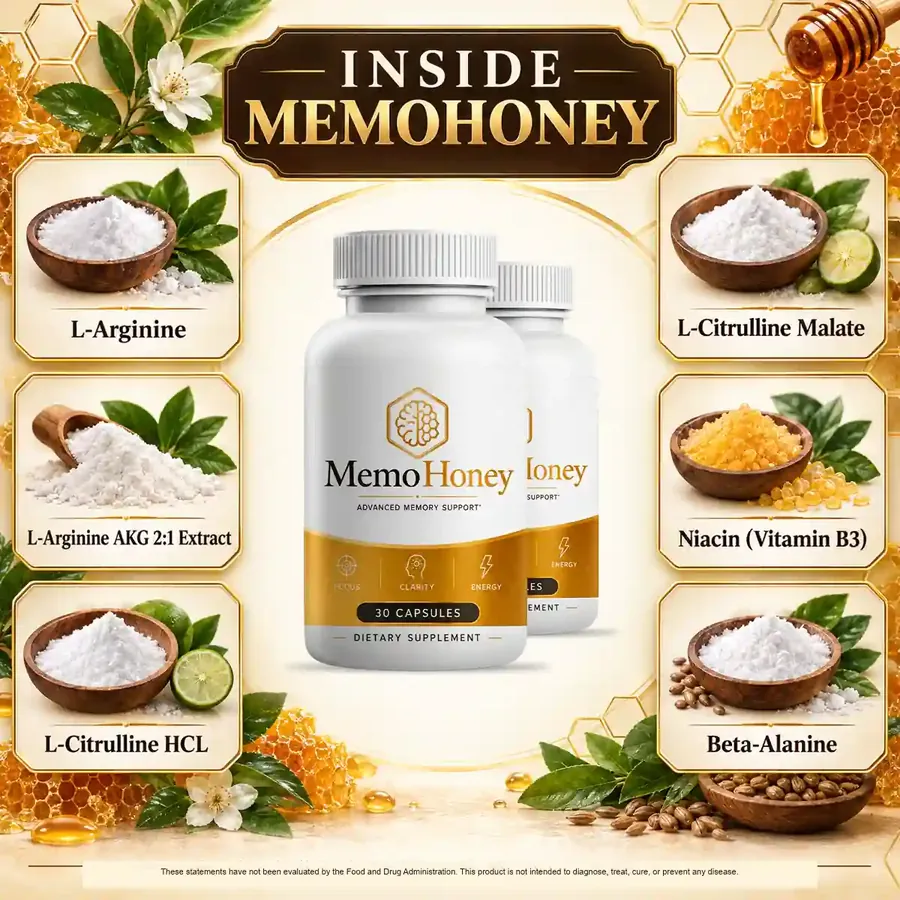
Worked example with MemoHoney
- Question 1: all seven lines show milligrams, so no blend hides anything. See the full panel.
- Question 2: 400 mg of arginine ingredients comes to roughly a fifth of the smallest daily dose in exercise research, where 2-20 g was used (NIH ODS, Exercise supplements). Citrulline sits at one-fifteenth of the low end, beta-alanine at one-fortieth.
- Question 3: for L-arginine, Mayo Clinic's evidence list is about the heart and blood vessels; memory never comes up (Mayo Clinic, L-arginine). Niacin helps memory only in severe deficiency (NIH ODS, Niacin).
Use the same three steps on any rival bottle. If the amounts are missing, the test ends at question 1.
Questions 4 and 5
Which FDA and FTC rules cover memory supplement claims?
The FDA does not approve supplements, and the FTC expects real evidence behind health claims.
No approval before sale
The FDA has no power to clear a supplement before it goes on sale (FDA, Supplement Q&A). A registered facility is not an approved product either (FDA, Approval myths). A bottle boasting FDA approval fails question 4. A supplement may not claim to cure or treat a disease, either.
Claims need proof
The FTC wants competent and reliable scientific evidence behind a health claim; customer stories do not count (FTC, Health claims). Federal warning letters went to sellers of Alzheimer's remedies in 2019. The FTC's verdict: "a cure-all often turns out to be a cure-nothing" (FTC, Alzheimer's claims letters).
Questions 6 to 8
How do you spot fake reviews, celebrity ads and lookalike names?
Check who wrote the praise, who is in the ad, and whether the name on the box matches the one you searched.
Staged praise
A 2024 FTC rule outlaws fake reviews and testimonials, AI-written ones included (FTC, Fake reviews rule). Watch for bursts of five-star posts and reviewers with no history (FTC, Online reviews).
Famous faces and recipes
Fake news stories with a borrowed celebrity, or a "honey recipe" for memory, are common hooks. No famous person stands behind MemoHoney.
Near matches
Separate products with similar names include MemoBoost, Memopezil, MemoGenesis, MemoCept and MemoPryl. Medihoney is a wound-care honey. Compare the distributor line before you pay.
Several web shops also use the MemoHoney name. Our where-to-buy notes cover what to compare.
Want to try MemoHoney?$49 a bottle in the 6-pack · 60-day refund window · 3+ bottles ship free
Order nowQuestions 9 and 10
Does the supplement fit your medicines, and can you get a refund?
Two questions that protect your health and your wallet. Ask them before checkout, not after.
Question 9: medicines
Take the bottle and your medicine list to a pharmacist. Ingredients that change blood pressure or blood sugar need the closest look. For MemoHoney, Mayo Clinic flags L-arginine with nitrates, diabetes medicines, sildenafil, blood thinners and pressure pills (Mayo Clinic, L-arginine). The interaction table lists them.
Question 10: refund terms worth reading
- How many days, counted from purchase or from delivery?
- Any minimum use before a claim?
- Opened bottles accepted?
- Who pays return postage, and to what address?
- How long until money reaches your card?
Our scorecard
How does MemoHoney score on the buyer's test?
Three passes, four partials and three fails. Strong on paperwork, weak on the memory case.
| # | Result | Why |
|---|---|---|
| 1 Amounts | Pass | Seven lines, seven printed amounts |
| 2 Doses | Fail | Small fractions of the studied amounts (NIH ODS, Exercise supplements) |
| 3 Memory research | Fail | Research on these amino acids targets sport and circulation |
| 4 FDA wording | Partial | Proper disclaimer; "FDA registered facility" badge names no facility |
| 5 Claim support | Fail | No published trial of the formula behind the sales-page promises |
| 6 Reviews | Partial | None verified yet; sales-page testimonials are the seller's own |
| 7 Ad hooks | Pass | No celebrity tie; the name, not the formula, says honey |
| 8 Identity | Partial | Distributor printed; lookalike shops use the name |
| 9 Medicines | Partial | Generic caution, no drug named |
| 10 Refunds | Pass | 60 days from purchase, after 30 days of use; buyer pays return postage |
Read the guarantee terms in full before ordering. The smallest order is two bottles for $158.
At a glance
MemoHoney's buyer's-test tally
FAQ
Buying a memory supplement: common questions
Are memory supplements a waste of money?
Often, for memory alone. NCCIH finds no clear benefit from the best-known memory ingredients (NCCIH, Supplements for cognition). Some people still buy one for a single nutrient they lack; a blood test tells you whether you do.
Why does a proprietary blend fail the label test?
Because a blend lists several ingredients under one combined weight. You cannot see how much of each sits inside, so the dose check stalls. MemoHoney has no blend; each line shows its own amount.
How can I tell if a supplement review is fake?
Look for bursts of posts on the same days, vague praise and reviewers with no other history (FTC, Online reviews). Fake and AI-written reviews are banned under an FTC rule (FTC, Fake reviews rule), but you cannot spot every one, so weigh the label more.
Is a clinically studied ingredient the same as a tested product?
No. An ingredient studied at grams for exercise says little about a capsule holding milligrams for memory. Ask whether the finished formula was tested; for MemoHoney, no trial has been published.
Why do so many memory supplement ads mention honey?
Honey stories make an easy hook, and some ads build on a kitchen recipe. MemoHoney carries the word in its name only; no honey appears on its label.
Can a memory supplement interact with my medicines?
Yes, depending on the ingredients. Products with L-arginine can clash with blood pressure, heart, blood thinner and diabetes drugs (Mayo Clinic, L-arginine). Show the bottle to your pharmacist first.
Who wrote this
Written and reviewed by
Plain-language pages built from the label, the sales page and linked public health sources.
Page last updated . Read our editorial standards and how we check the reviews. This website is run by a U.S. shop that sells MemoHoney, not by the maker (the label says distributed by Instituto Experience, Ogden, UT). This site earns money when you buy through its order links.
Keep reading
More about MemoHoney
Supplement Facts
Every part of the MemoHoney bottle decoded, the badges checked against the printed label, and the gaps listed.
Read more
Reviews
Why the review slots are still blank, how buyers get matched, and where a MemoHoney complaint should go.
Read moreTesting & quality
Which MemoHoney quality facts are on paper, which badges name nobody, and what to ask the distributor.
Read moreOfficial U.S. MemoHoney shop
Ready to try MemoHoney?
Pick 2, 3 or 6 bottles on the sales page. Six bottles bring the price to $49 each, and 3 or more ship free in the U.S.
- Secure checkout
- 60-day window
- Ships from the U.S. with tracking