The theory
How Does MemoHoney Work? Nitric Oxide, Step by Step
MemoHoney's sales page says its amino acids feed nitric oxide and increase blood flow to the brain, which it links to memory.
NIH-reviewed exercise trials gave people grams of arginine daily (NIH ODS, Exercise supplements). The capsule's two arginine lines total 400 mg.
Written by the MemoHoney editorial teamUpdated
The pitch
How does MemoHoney claim to work?
Through circulation. The seller connects its amino acids to nitric oxide, wider vessels and more blood reaching the brain.
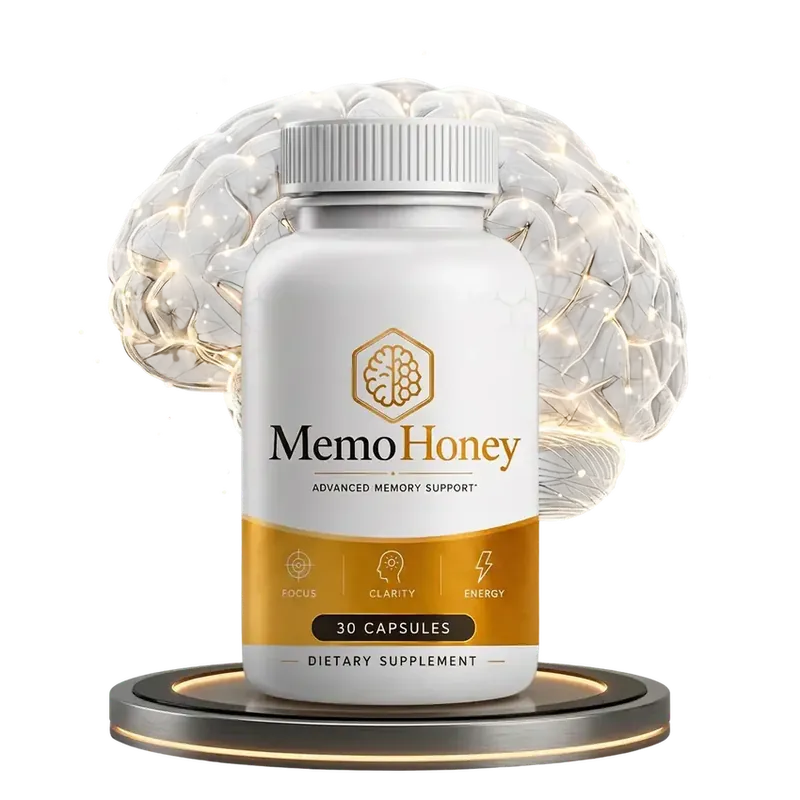
On the bottle, the promise is short: "Advanced Memory Support*". Online, the seller adds that the capsules can "increase cerebral blood flow" and names memory, focus, clarity and brain health as targets.
We quote those lines so you can weigh them. The seller offers no study of MemoHoney in support, and the asterisk on the bottle leads to the usual FDA disclaimer.
Most of the theory hangs on two ingredients, L-arginine and L-citrulline, each listed twice in different forms.
Step by step
What is the nitric oxide idea behind MemoHoney?
A four-link chain. The first three links are ordinary body chemistry; the fourth is the marketing.
1. Swallow the capsule
Two arginine forms come to 400 mg together; two citrulline forms come to 200 mg.
2. Make nitric oxide
Arginine is a raw material for nitric oxide, and the body can convert citrulline into arginine.
3. Relax vessel walls
Nitric oxide works as a chemical messenger. One of its jobs is telling blood vessels to loosen.
4. The memory claim
The seller's step. Nobody has shown a capsule pushes links 2 and 3 far enough to reach it.
The weak joint sits between "the body uses this" and "swallowing extra changes something". Owning bricks does not make a builder work faster.
The evidence
What did NIH-reviewed studies find about arginine and nitric oxide?
Gram-sized arginine doses mostly failed to lift nitric oxide or circulation. Citrulline's results were too thin to lean on.
Sport is where these amino acids have been tested hardest, and the NIH exercise fact sheet gathers those trials (NIH ODS, Exercise supplements). The findings:
- Arginine: people took anywhere from 2 g up to 20 g a day. Performance barely moved, and in most trials neither nitric oxide nor blood flow rose.
- Citrulline: 41 weightlifters on 8 g of citrulline malate managed more reps. In a different trial, 3 g before a treadmill test led to worse results than a placebo. The NIH reviewers judged the overall support as not strong.
- Memory: absent from the sheet for both.
If grams of arginine rarely raised nitric oxide in working muscle, a few hundred milligrams face a long climb before reaching the brain. That is our inference from the data, not a test of the capsule.
Doses in context
How does one MemoHoney capsule compare with studied amounts?
Each bar sets the label figure next to the smallest amount in the cited trials.
Put as fractions: 400 mg of arginine ingredients against 2,000 mg is a fifth. 200 mg of citrulline against 3,000 mg is a fifteenth. 40 mg of beta-alanine against 1,600 mg is a fortieth. The bottle caps you at one capsule, so closing the gap by swallowing more is off the table.
The other lines
What role do beta-alanine and niacin play in MemoHoney?
The label assigns neither one a job. Their research records point somewhere else.
| Line | Per capsule | Purpose on label | Research subject |
|---|---|---|---|
| Arginine (two forms) | 400 mg | None given | Workouts, blood pressure, circulation (NIH ODS, Exercise supplements) (Mayo Clinic, L-arginine) |
| Citrulline (two forms) | 200 mg | None given | Workouts, thin support (NIH ODS, Exercise supplements) |
| Beta-alanine | 40 mg | None given | Brief, intense exercise; mixed findings (NIH ODS, Exercise supplements) |
| Niacin | 7.5 mg NE | None given | Vitamin B3; memory suffers when it is badly lacking (NIH ODS, Niacin) |
| Calcium | 18 mg | None given | 1.5% of the Daily Value |
The seller pitches the capsule as a single memory product and skips a line-by-line rationale. Beta-alanine is a gym ingredient at a sliver of gym doses. Niacin is a genuine vitamin at roughly half a day's need, and it bears on memory only for someone with a real shortage.
Want to try MemoHoney?$49 a bottle in the 6-pack · 60-day refund window · 3+ bottles ship free
Order nowOpen questions
What is still unknown about how MemoHoney works?
Most of the chain. Several basic questions have no published answer.
Does the formula do anything?
Nobody has run a trial on MemoHoney, so any effect on memory, focus or circulation is untested.
Do milligrams matter?
Trials used grams. What 400 mg of arginine ingredients does in a human brain is unknown.
Why before a meal?
The label sets 20 to 30 minutes ahead of eating and stops there. We do not fill in a reason.
Which niacin form?
Nicotinic acid and nicotinamide act differently, and the panel names neither.
Medical reality
Is MemoHoney a treatment for dementia or memory loss?
It is not. There is no direct evidence that any supplement can prevent Alzheimer's or other dementias (NCCIH, Supplements for cognition). Memory can slip because of depression, a medicine reaction, thyroid trouble or kidney and liver disease, and those can be treated, so a capsule should never push back a doctor's visit. Never stop or change a prescribed dose on your own.
Your call
How can you judge MemoHoney for yourself?
Four checks, done in order, turn the 60-day window into a fair test.
- Hold the panel up against your other supplements, niacin totals especially.
- Talk to your doctor or pharmacist first if you use heart, blood pressure, nitrate, ED or blood-thinning medicine.
- Jot down how your days go before the first capsule, then again at day 30.
- Make the call before day 60, when the seller's money-back window closes.
Two bottles cost $158 and six cost $294; the pack comparison covers the middle option.
FAQ
How MemoHoney works: common questions
Has anyone studied the MemoHoney capsule itself?
Not in any published trial we could find. The seller's case leans on a nitric oxide theory and on single-ingredient research, mostly in athletes and at gram doses. Until the capsule itself is tested, any promised effect is a guess.
What is nitric oxide's job in the brain?
It acts as a chemical messenger, and one of its roles, in the brain and elsewhere, is helping vessel walls relax. Swallowing its building blocks is another story: in exercise trials, grams of arginine usually failed to lift nitric oxide (NIH ODS, Exercise supplements).
Will MemoHoney send more blood to my brain?
The seller says so, but offers no measurement. In NIH-reviewed trials, even 2 g to 20 g of arginine daily mostly left circulation unchanged (NIH ODS, Exercise supplements). MemoHoney's two arginine lines add up to 400 mg, far less than that.
Is nitric oxide good for brain fog?
No good evidence says supplements that target nitric oxide clear brain fog. Poor sleep, medicine side effects, low B12, thyroid problems and depression can all cloud thinking. A clinician can look for those, and several have real treatments (NCCIH, Supplements for cognition).
Do arginine and citrulline work together?
The body can turn citrulline into arginine, so brands often pair them. Whether 400 mg plus 200 mg in one capsule beats either alone has never been tested. The cited trials looked at each amino acid on its own, at far larger amounts.
Can MemoHoney replace memory medicine?
No. It is a supplement, and nothing shows it treats memory loss or dementia (NCCIH, Supplements for cognition). Keep taking your prescribed medicine, and bring the label to your doctor before you add it, above all if you use heart or blood pressure drugs.
What makes MemoHoney different from a pre-workout?
The ingredient types overlap: arginine, citrulline and beta-alanine are pre-workout staples. The differences are the memory label, the added niacin and calcium, and amounts in milligrams rather than the grams used in sport research (NIH ODS, Exercise supplements).
Who wrote this
Written and reviewed by
Plain-language pages built from the label, the sales page and linked public health sources.
Page last updated . Read our editorial standards and how we check the reviews. This website is run by a U.S. shop that sells MemoHoney, not by the maker (the label says distributed by Instituto Experience, Ogden, UT). This site earns money when you buy through its order links.
Keep reading
More about MemoHoney

Benefits
Eight MemoHoney promises graded one by one, plus the practical upsides that really hold.
Read more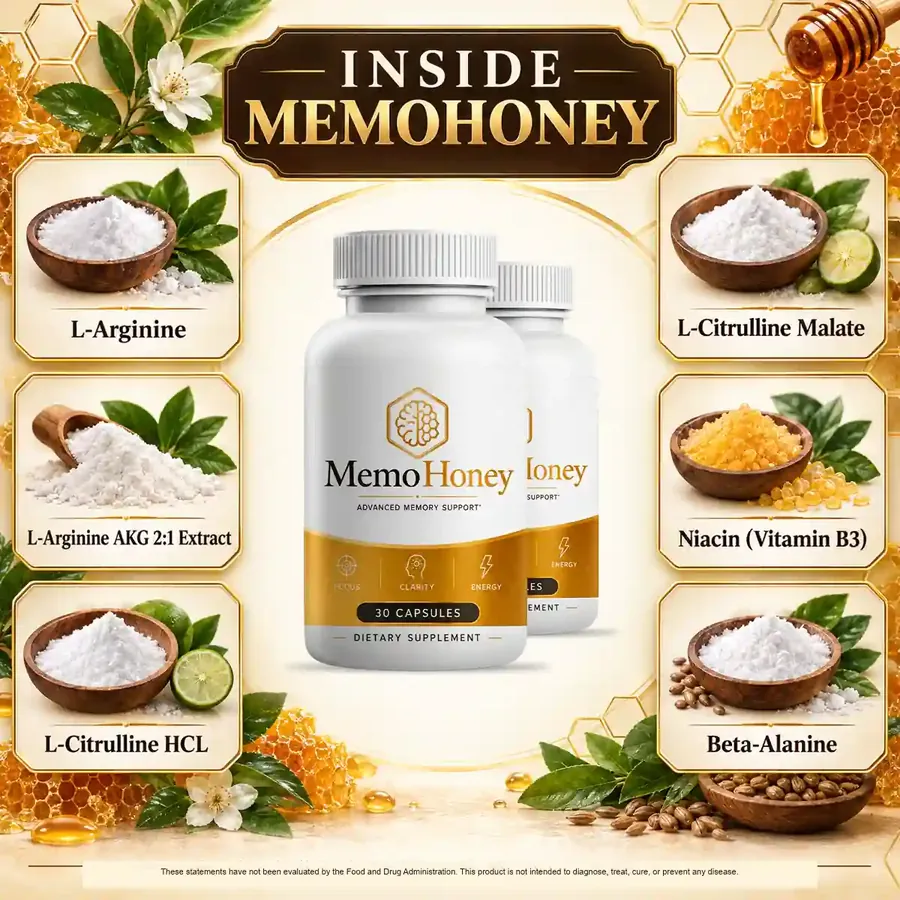
L-arginine
Two arginine lines, 400 mg in all: who can relax, who should ask a doctor, and which drugs clash.
Read more
Results timeline
A week-by-week plan for testing MemoHoney yourself, timed to the 60-day refund window.
Read moreOfficial U.S. MemoHoney shop
Ready to try MemoHoney?
Pick 2, 3 or 6 bottles on the sales page. Six bottles bring the price to $49 each, and 3 or more ship free in the U.S.
- Secure checkout
- 60-day window
- Ships from the U.S. with tracking